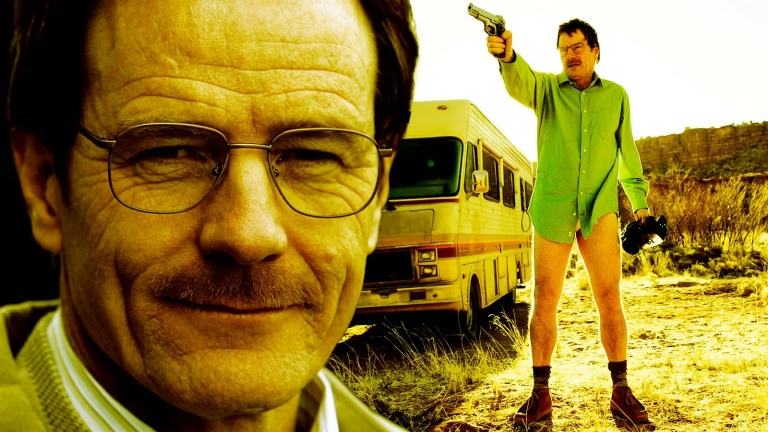
The Price of Heisenberg: How Playing Walter White Cost Bryan Cranston His ‘Nice Guy’ Career Forever
Every actor who plays a monster pays a price.
Sometimes it is typecasting. Sometimes it is the slow erosion of the roles that used to come naturally, the parts that required a face audiences trusted, a presence that felt safe. Sometimes it is something harder to name, a subtle shift in how a room responds when you walk into it, a change in what people see when they look at you.
Bryan Cranston played Walter White for five years. He did it so completely, so honestly, so without vanity or self-protection, that he made television history. He also made it impossible to ever go back.
The nice guy career was over. And the most interesting thing about that is that Cranston would not change a single frame of it.
What He Was Before
To understand what Breaking Bad cost Bryan Cranston, you have to understand what he had built before it.
For three decades, Cranston had cultivated something genuinely rare in Hollywood. He was universally liked. Not just tolerated, not just respected, but actively, warmly liked by audiences across demographics, across generations, across every divide that usually fractures public affection. As Hal in Malcolm in the Middle, he had spent seven seasons being the kind of father figure that made people feel good. Chaotic, yes. Incompetent, often. But fundamentally harmless. Fundamentally safe. Fundamentally on your side.
That reputation was not an accident. It was the product of thirty years of careful, committed work. Guest spots, supporting roles, sitcom performances, all of it building toward a version of Bryan Cranston that the public held with uncomplicated affection. He was the guy you were always glad to see. The face that made you relax.
Breaking Bad did not just change that reputation. It detonated it.
The Cost of Full Commitment
The reason Walter White worked, the reason the performance became the benchmark against which every subsequent television antihero would be measured, is that Cranston held nothing back. There was no winking at the camera, no subtle signal to the audience that the real Bryan Cranston was still in there somewhere, still the lovable Hal underneath the Heisenberg hat. He committed to Walter White’s psychology completely, including the parts that were genuinely ugly, genuinely irredeemable, genuinely frightening.
That level of commitment has a cost that most actors never have to pay, because most actors never commit that fully.
When you spend five years inhabiting a man defined by boundless pride, by the need to dominate, by the willingness to destroy anyone who stands between him and recognition, something of that energy clings to you in the public imagination. It is not rational. Audiences know, intellectually, that actors are not their roles. But the emotional residue of a performance that powerful does not respond to intellectual arguments. It settles into the gut. It changes the instinctive response.
After Breaking Bad, audiences could no longer look at Bryan Cranston without seeing, somewhere behind his eyes, the capacity for Heisenberg. The warmth was still there. The talent was undeniable. But the uncomplicated safety was gone forever.
The Roles That Stopped Coming
The practical consequences were immediate and lasting.
The family entertainment pipeline, the sitcom offers, the roles that required a face that signaled pure, unambiguous goodness, those dried up. Not entirely, not overnight, but the shift was real and measurable. Hollywood, which had spent thirty years casting Cranston as the harmless everyman, suddenly saw something else when it looked at him. Something more complicated. Something that required more careful handling.
In one sense, this was a promotion. The roles that replaced the sitcom dad work were meatier, more complex, more demanding. Cranston moved into prestige drama, into films that wanted the weight and darkness he had demonstrated he could carry. He was no longer the reliable comic relief. He was the guy you called when you needed someone to make an audience genuinely uncomfortable.
But something was lost in that transition, and it would be dishonest to pretend otherwise. The ease was gone. The automatic warmth, the reflex of public affection that had been his greatest professional asset for three decades, had been permanently complicated by five seasons of Walter White. Every role he took after Breaking Bad carried the shadow of Heisenberg into the room with it.

The Price Walter Paid, and the Price Bryan Paid
There is a parallel worth examining between the character and the actor.
Walter White’s story is about a man who finally allowed himself to be who he truly was, and who discovered that the cost of that authenticity was everything he claimed to value. His family, his freedom, his life. He got to be Heisenberg, fully and completely, and it destroyed him.
Cranston’s story is not so dark, but the structure rhymes. He got to play the role of a lifetime, to do the work he was born to do, to demonstrate a range and a depth that thirty years of sitcom work had never allowed him to show. He got to be, as an actor, fully and completely himself. And the cost was the comfortable career he had spent three decades building.
The nice guy was gone. The safe pair of hands was gone. The face that made audiences relax without thinking about it was gone, replaced by something richer and more unsettling and infinitely more interesting.
Why He Would Do It Again
Here is the thing about prices worth paying. You do not regret them.
Cranston has spoken, in various interviews, about the gift that Breaking Bad represented. Not just professionally, though the professional transformation was seismic. But personally, as an artist. The chance to do work that mattered, to inhabit a character of genuine psychological complexity, to be part of something that changed what television could be and do and say about human nature.
That is not the language of a man mourning what he lost. That is the language of a man who understood, clearly and without illusion, exactly what the transaction was, and who made it with open eyes.
Walter White told Skyler, in his final honest moment, that he did it for himself. That he liked it. That he was good at it. That for the first time, he felt truly alive.
Bryan Cranston played Walter White for five years. He did it for himself. He was extraordinary at it. And whatever it cost him, whatever version of his career died in that New Mexico desert alongside Heisenberg, the performance he left behind will outlast every safe, comfortable, universally beloved role he ever played.
Some prices are worth every penny.