
Adrien Brody: The Oscar That Killed His Career
On March 23, 2003, Adrien Brody became the youngest Best Actor winner in Oscar history. He was 29 years old. He kissed Halle Berry on stage in a moment of unscripted, electric chaos. He delivered a somber, emotional speech pleading for peace as the Iraq War loomed. He had the raw, complex gravity of a young Dustin Hoffman. The world was watching, and the world was certain: this man was about to become one of the greatest stars of his generation.
It didn’t happen. And the reason why tells you everything about what Hollywood actually values.
The Price He Paid to Get There
Before we talk about what the Oscar took from him, we need to understand what it cost him to win it.
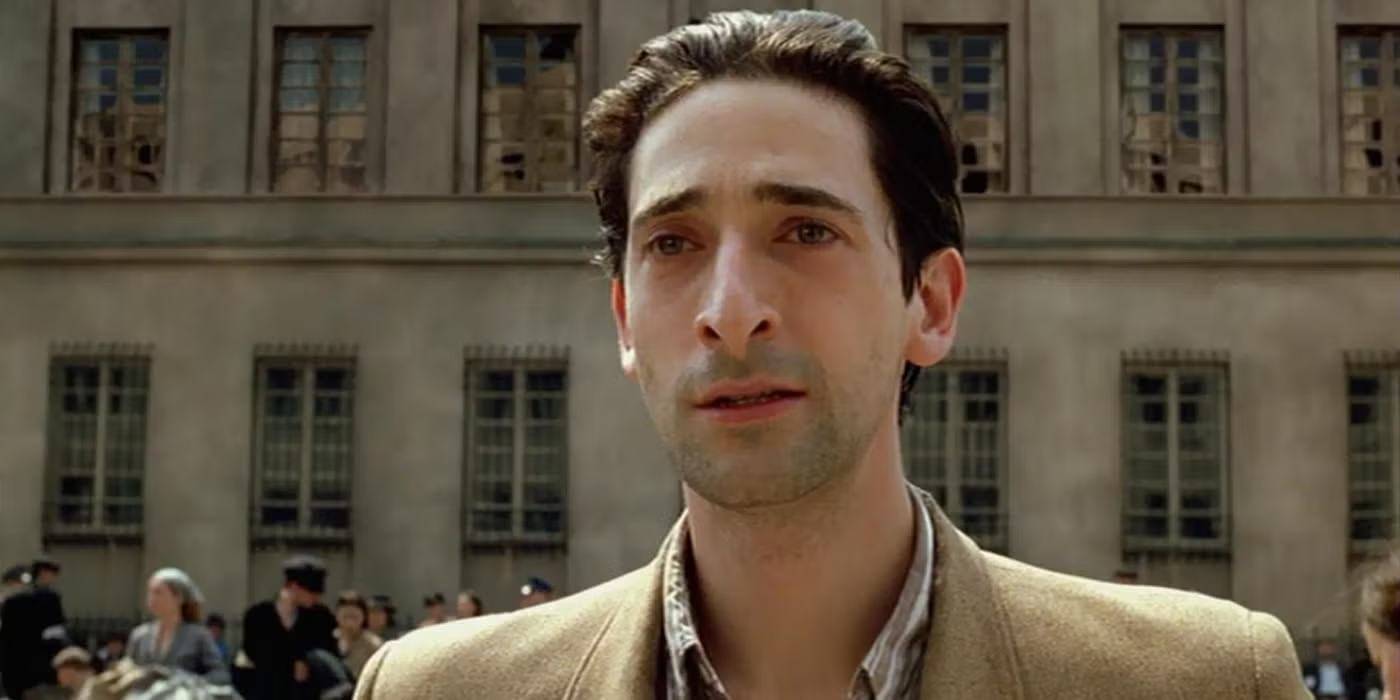
For Roman Polanski’s The Pianist, Brody didn’t just prepare for a role, he dismantled his entire life. He gave up his apartment. He sold his car. He moved to Europe. He starved himself down to 129 pounds. He practiced Chopin for four hours every single day and refused a hand-double for the piano sequences. This wasn’t method acting as a PR talking point. This was a terrifying level of artistic sacrifice that produced one of the most haunting performances in modern cinema.
He conquered the industry at its highest level. The tragedy is that the industry he conquered was already disappearing.
Hollywood Didn’t Want What He Was Selling
The years following his Oscar win coincided with one of the most dramatic shifts in Hollywood history. The mid-budget adult drama — the exact kind of film that made Brody a star — was being quietly strangled by the rise of the superhero franchise machine. Studios weren’t looking for the next Dustin Hoffman. They were looking for the next Chris Evans.
Brody found himself caught in an impossible trap. He was too expensive for the gritty independent films that suited his talent. But he was too unconventional, too strange, too interesting to anchor a $200 million blockbuster. Hollywood had no idea what to do with him — so they tried to force him into a mold that was never built for him.

The Blockbuster Experiment That Went Wrong
In 2005, Brody starred in Peter Jackson’s King Kong. The film grossed nearly $557 million worldwide — the highest-grossing film of his career. By every commercial metric, it was a success. But watch Brody in that film and you can feel the friction. A complex, unconventional talent trapped in a green-screen playground, playing a role that demanded the kind of glossy, conventional heroism he had actively avoided his entire career.
Then came Predators in 2010. Brody gained 25 pounds of muscle for the role, attempting to reinvent himself as a modern action figure. It was a fascinating swing — but it didn’t land. He had the face of a 1940s poet, not a modern action hero. The tough-guy routine felt forced because it was forced. Hollywood was jamming a square peg into a very expensive, round hole.
Finding Sanctuary With Wes Anderson
While the blockbuster experiment was bleeding out, Brody found something more valuable than box office returns: a creative home.
Starting with The Darjeeling Limited in 2007, he became a recurring presence in Wes Anderson’s meticulously crafted cinematic universe. Over five films — including Fantastic Mr. Fox and The Grand Budapest Hotel — he evolved into an essential, irreplaceable piece of Anderson’s puzzle. A highly specialized, brilliant chameleon thriving in curated cinematic spaces.
But here’s the cost: artistic fulfillment and commercial dominance are not the same thing. By retreating into Anderson’s world, Brody was drifting further from the mainstream. He was becoming prestige garnish on a brilliant auteur’s vision rather than a marquee name in his own right. The industry had pushed him to the margins, and the margins — however artistically rich — don’t keep you on the A-list.
The Wilderness Years
By the 2010s, Brody was stranded in what can only be described as box-office purgatory. The middle class of cinema had collapsed. The industry was now polarized between billion-dollar cinematic universes and microscopic indie films. Brody was too expensive and prestigious for tiny independent budgets, yet too risky and unconventional to lead a corporate franchise.
The result? A string of highly lucrative, deeply strange international roles — Chinese blockbusters like Dragon Blade and Air Strike — that confused his core American audience and made his career trajectory feel aimless. It wasn’t aimless. It was the logical outcome of an industry that had structurally eliminated the space where someone like Adrien Brody was supposed to exist.
Around 2015, he made a striking move: he pivoted his creative energy entirely toward the visual arts. He debuted a painting exhibition titled Hot Dogs, Hamburgers, and Handguns — work that critiqued the instant gratification of American violence and reflected a deep disillusionment with the entertainment industry. He wasn’t waiting for Hollywood to figure out what to do with him. He was reclaiming his artistic autonomy on his own terms.
The Comeback That Was Actually an Indictment
The return didn’t come with a blockbuster. It came slowly, deliberately, through prestige television. His work on Peaky Blinders was a masterclass in menace. His appearance on Succession was devastating. Audiences were reminded — or perhaps discovered for the first time — just how singular and magnetic his presence could be.
Then came The Brutalist. Brady Corbet cast him as a Jewish architect surviving historical trauma — a role with undeniable, deeply poetic parallels to The Pianist. Brody poured twenty years of industry frustration into the performance. The result was a monumental, career-defining achievement. In March 2025, at 51 years old, he won his second Academy Award for Best Actor, shattering the twenty-year narrative of his own supposed demise.
But here’s what the celebration misses: his comeback isn’t just a feel-good story. It’s a glaring indictment of the modern Hollywood machine. Adrien Brody never lost his talent. The industry simply forgot how to utilize complex, unconventional leading men — and spent two decades proving it.
The Real Lesson
The Oscar didn’t destroy Adrien Brody. Hollywood’s inability to evolve did. The award placed him at the pinnacle of an industry that was about to abandon everything that made him valuable. He was handed the keys to a kingdom that was already being demolished.
What makes his story so uncomfortable is that it isn’t really about him. It’s about a system that claims to celebrate greatness while systematically eliminating the conditions that allow greatness to exist. Brody survived it. Most don’t even get the chance to try.
The youngest Best Actor winner in history had to wait until he was 51 to prove the industry wrong. That’s not a comeback story. That’s a 22-year indictment.


