

Brendan Fraser Gave Hollywood His Spine, They Took His Voice
There’s a video of Brendan Fraser at the 2023 Oscars, clutching his Best Actor trophy, that most people misread completely. They see redemption. They see a happy ending. They see a man who finally got what he deserved.
But watch his hands. Watch how tightly he grips that statue, like someone who’s been told his entire life that gravity doesn’t apply to him, only to learn the hard way that it does. That tremor isn’t joy. It’s the muscle memory of a man who spent twenty years waiting for someone to take it away again.
Because they already took everything else.
The official story goes like this: Brendan Fraser was the biggest movie star on the planet in 1999, then he made bad choices, got old, and faded away. A cautionary tale about not adapting to changing times. The internet turned him into the “Sad Brendan” meme, and we all moved on.
But the real story is simpler and infinitely darker.
Hollywood didn’t just take Fraser’s career. They took his spine. Literally. And when he tried to speak about what happened to him, they took his voice too.
The Bill Always Comes Due
Let’s start with the body. The thing we all watched and never really saw.
Between 1997 and 2008, Brendan Fraser underwent a series of surgical procedures that read less like a medical chart and more like a casualty report from a war zone. A laminectomy to remove part of a vertebra in his spine. It failed. They had to do it again a year later. A partial knee replacement. Vocal cord surgery. A procedure where surgeons literally bolted the compressed pads of his spine together because his back was collapsing.
In a 2018 interview, Fraser described building what he called a “personal exoskeleton” just to get out of his trailer. Ice packs. Compression pads. Tape. He said he was “put together with tape and ice.”
This is what we were laughing at when we watched him run into trees in George of the Jungle. This is what was happening behind the pratfalls in The Mummy franchise that made $848 million. We loved Tom Cruise for doing his own stunts. We called it dedication. But nobody talked about the invoice that gets delivered when the cameras stop rolling.
Fraser paid it. In cartilage. In bone. In vertebrae that no longer functioned the way human spines are supposed to.
But the physical destruction was just the down payment. The real cost came due on a sunny afternoon in Beverly Hills in 2003.
The Handshake That Wasn’t
The Beverly Hills Hotel. A luncheon for the Hollywood Foreign Press Association, the gatekeepers who vote on the Golden Globes. Fraser was there doing what movie stars do: shaking hands, making nice with the people who could boost his career or destroy it.
Philip Berk, former president of the HFPA, one of the most powerful men in the organization, approached him.
The handshake was a lie.
According to Fraser’s account, Berk’s left hand reached around and grabbed him. Not a pat on the back. Not a friendly squeeze. Berk’s finger penetrated him, moved around, violated him in a public space where Fraser’s only option was to freeze or cause a scene that would end his career anyway.
Fraser managed to remove Berk’s hand. He ran past a police officer outside the hotel but couldn’t speak. He went home and told his wife, terrified and humiliated.
His representatives demanded an apology. The HFPA investigated. And their response was a masterclass in institutional gaslighting.
Berk’s letter to Fraser didn’t admit guilt. It said, “If I’ve done anything that upset Mr. Fraser, it was not intended and I apologize.” That word: “if.” Later, in his own memoir, Berk admitted to “pinching” Fraser but claimed it was a joke. The HFPA backed him up, telling Fraser that while the touch may have been inappropriate, it was meant as humor, not assault.
They asked Fraser to sign a joint statement saying it was all a misunderstanding. Fraser refused. And then came the silence.
The Soft Blacklist
Hollywood doesn’t fire you with a press release. There’s no official memo titled “Brendan Fraser Is Banned.” That’s not how power operates in an industry built on relationships and whispers.
Fraser calls it the “soft blacklist.” Suddenly, the Golden Globe invitations stopped arriving. The phone stopped ringing. Studio executives who needed the HFPA’s blessing for their awards campaigns stopped seeing Fraser as a star and started seeing him as a liability, a man who refused to play along with the unspoken rules.
From 2008 to 2018, Fraser entered what he calls “the wilderness.” His films went straight to DVD. Furry Vengeance. Whole Lotta Sole. Pawn Shop Chronicles. Not just bad movies but desperate ones, the work of a man trying to stay afloat while paying $900,000 a year in alimony and child support with zero guaranteed income.
In 2013, he petitioned courts to reduce his payments, revealing he had “zero dollars” in guaranteed movie deals. The man who carried $400 million franchises was broke.
And the internet, because the internet is cruel, turned him into a meme. A photo of him looking emotional in an interview became “Sad Brendan.” People mocked his weight, his hair, the visible ruin of a man carrying the private trauma of surgeries, divorce, assault, and industry abandonment.
He had given Hollywood his spine. They had taken his voice. And then they laughed while he suffered in silence.
The Voice Reclaimed
The turn came in 2018 when Fraser sat down with GQ and spoke. He named Philip Berk. He told the story of the assault. He showed the scars, physical and psychological.
The reaction was immediate. The internet stopped laughing. The “Brenaissance” began, not as marketing but as collective guilt and recognition.
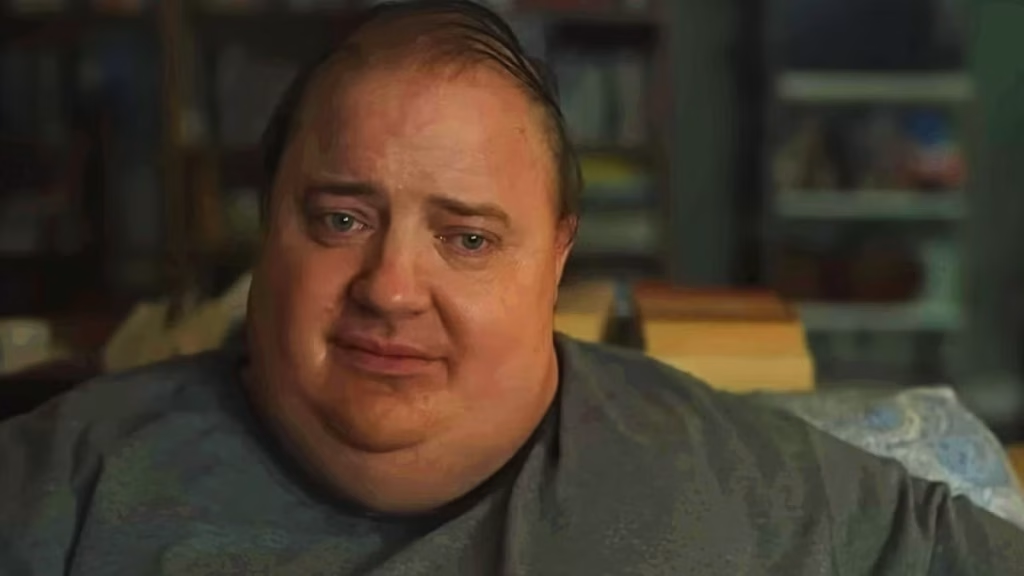
Then came The Whale. Director Darren Aronofsky cast him as Charlie, a dying man seeking redemption. At the Venice Film Festival premiere, the audience gave him a six-minute standing ovation. You can watch him try to deflect it, try to leave, but they won’t let him. He breaks down completely.
Five months later, he won the Oscar.
The Price of Speaking
Here’s what the industry wants you to believe: Brendan Fraser’s comeback is a heartwarming tale of redemption, proof that Hollywood rewards talent and persistence.
But that’s not what happened. Fraser didn’t get his career back because the system suddenly developed a conscience. He got it back because he reclaimed his voice, because he refused to stay silent, and because audiences remembered what the gatekeepers wanted them to forget.
Hollywood took his spine through years of brutal physical demands. They took his voice by punishing him for speaking truth about assault. And when he finally spoke anyway, they couldn’t take the one thing that mattered most: his refusal to disappear.
The trophy on his shelf isn’t a gift from the industry. It’s evidence of survival. It’s proof that sometimes, even when they take everything, they can’t take the part of you that refuses to be erased.
They just can’t call that a joke.


