The Actor Hollywood Tried to Fix for 30 Years—And Why His Refusal Made Him Untouchable
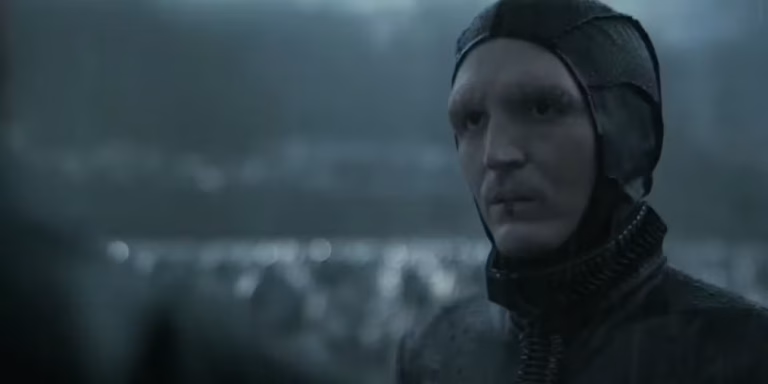
In 2024, the internet did something strange. They looked at a man with no nose, skin like rotted leather, and the overall appearance of a corpse that had been microwaved—and they called him a heartthrob.
The character was The Ghoul from Amazon’s Fallout. The actor underneath all that silicone and prosthetics was Walton Goggins. And the reason millions of people found a literal radioactive monster sexually attractive tells you everything you need to know about what happens when an actor spends thirty years refusing to be fixed.
Because make no mistake: Hollywood has been trying to fix Walton Goggins since the moment he arrived in Los Angeles in 1991 with three hundred dollars and a dream. They wanted to fix his teeth. They wanted to fix his accent. They wanted to fix his face, his intensity, his entire approach to existing in front of a camera. The industry looked at Goggins and saw a problem that needed solving—a collection of defects standing between a talented man and a paycheck.
What they didn’t understand was that those defects were the entire point.
The Anatomy of a Mistake
To understand what Hollywood wanted to fix, you first need to understand what they were looking for. When Goggins stepped off the bus in LA, the industry was operating on a simple binary: Heroes and Villains. Heroes were symmetrical. They were Chris Evans, Brad Pitt, the blank canvas of conventional attractiveness onto which audiences could project their fantasies. Villains were specific—scarred, accented, textured. They had “character.”
Goggins didn’t fit either category.
He calls it having a “High-Definition Face.” A receding hairline that creates a forehead you could project a movie onto. A set of teeth—courtesy of a childhood diving accident—that are too white, too perfect in their artificiality, creating a smile that registers somewhere between charm and menace. He was too intense to be the romantic lead, but too charismatic to disappear into the background as a disposable thug.
The industry hates that kind of ambiguity. If you can’t be categorized, you can’t be sold.
So they tried to help him. His agents told him to lose the Georgia accent—it was “limiting.” They told him to soften his intensity—it was “too much.” The subtext was clear: if you want to work, you need to sand down everything that makes you specific and become something generic enough to fit into the pre-existing holes in our machine.
For a decade, Goggins was “Guard #1” and “Thug #2.” If a script needed someone to yell a racial slur before getting punched by the hero, Goggins got the call. He was a professional extra in his own career, waiting for permission to be taken seriously.
The cruel irony? In 2001, he and his partner Ray McKinnon made a short film called The Accountant. It was dark, Southern, weird. It won an Academy Award. Goggins had an Oscar on his shelf, but he still couldn’t get a meeting for a leading role. Hollywood respected the talent. They just couldn’t get past the packaging.

The Price of Refusing
Here’s what refusing to be fixed actually cost him: twenty years of being everyone’s second choice.
When he finally broke through on The Shield in 2002, playing Detective Shane Vendrell, the role should have been a career launcher. Instead, it became a career trap. He spent seven seasons transforming a one-note racist cop into a figure of Shakespearean tragedy, delivering one of the most harrowing performances in television history in the series finale. But the industry didn’t see the nuance. They saw the type. After The Shield ended in 2008, Goggins wasn’t the Oscar-winning producer or the versatile actor. He was Shane Vendrell, the racist Southern cop.
He had become radioactive. Casting directors couldn’t separate the man from the monster.
This is the cost the prompt asks us to calculate—not in money or fame, but in psychological terms. Goggins had proven he could devastate an audience, and his reward was being locked in a box labeled “Southern Thug.” The very intensity and specificity that made him brilliant now threatened to drown him. Every audition became an argument about whether he could be anything other than what they’d already seen.
Most actors would have pivoted. They would have taken the elocution lessons, done the rom-com, proven they could “do different.” They would have fixed themselves.
Goggins doubled down.
The Weapon
When Justified came calling in 2010 with an offer to play Boyd Crowder—a white supremacist neo-Nazi who dies in the pilot episode—Goggins said no. He told showrunner Graham Yost he wasn’t interested in playing “a white supremacist who is just a white supremacist.” He knew that another dumb redneck would cement his typecasting forever.
But then he made a counter-offer that revealed his entire strategy: he would play the Nazi, but only if he could play him as the smartest man in the room.
This is where the teeth became a weapon. Instead of hiding the artificial, gleaming smile that agents said was “too much,” Goggins turned it into Boyd Crowder’s signature—a dazzling, terrifying grin that belonged to a smiling cobra. He rejected the “dumb hillbilly” trope entirely, making Boyd loquacious, philosophical, a man who used forty-dollar words to justify ten-cent crimes.
Watch the pilot. In scenes where Boyd should be menacing, Goggins is polite, almost courtly. He treats the hero Raylan Givens not like a cop but like an old friend he just happens to be trying to kill. It was a mutiny against the script itself. By refusing to play the monster as a monster, he forced the audience to fall in love with him.
The writers were supposed to kill Boyd in Episode 1. Instead, they kept him alive for six seasons. The disposable villain became the co-lead, standing toe-to-toe with Timothy Olyphant—the quintessential Handsome Hero—and stealing scenes with nothing but that voice, those teeth, and that forehead.
But Goggins wasn’t done proving his point.
Breaking the Machine
In 2012, firmly established as the king of FX tough guys, Goggins was offered a guest spot on Sons of Anarchy—the most hyper-masculine show on television. Everyone expected another gangster, another violent redneck. Instead, Goggins asked to play Venus Van Dam, a transgender sex worker.
In the wrong hands, this is a disaster waiting to happen. In 2012, Hollywood’s track record for trans representation was abysmal—usually comedic, usually exploitative. But Goggins didn’t play Venus for laughs. He played her with the same tragic seriousness he brought to Boyd Crowder. He showed up in full makeup and prosthetics and didn’t wink at the camera. There’s a scene where Venus confesses her love to Tig, one of the bikers, and it’s raw and genuine and completely shatters any remaining box the industry tried to put him in.
You can’t call a man a “Southern Thug” when he seamlessly transitions from neo-Nazi bank robber to vulnerable trans woman in the same calendar year.
He had broken the machine. And once the machine was broken, the biggest directors in the world came looking.
The Untouchable
Quentin Tarantino has a fetish for textured faces, for actors who look like they’ve lived. He cast Goggins in Django Unchained and gave him a lead role in The Hateful Eight, putting him in a room with Samuel L. Jackson and Kurt Russell. Goggins didn’t just survive—he stole the third act. When Tarantino calls you a “generational talent,” it’s the Hollywood equivalent of being knighted.
Which brings us to The Ghoul.
The role is the final proof of concept. Goggins is buried under pounds of prosthetics, playing a man who’s been turned into a monster by radiation. He has no nose. He looks like beef jerky left in the sun for two centuries. By traditional Hollywood standards—the symmetry, the Chris Evans algorithm—he should be unwatchable.
Instead, he became a sex symbol.
People didn’t see the makeup. They saw the charisma bleeding through it. That voice—the one agents told him to lose—projected a weary, dangerous cowboy cool that no amount of CGI could replicate. He took a literal monster and made him the most compelling leading man on streaming television.
This is what refusing to be fixed actually looks like when it works. Goggins never got the hair plugs. Never took the accent-reduction classes. Never filed down the edges that made him specific. He looked at every box Hollywood tried to stuff him into and burned it down, then built his career in the ashes.
The Real Cost
But here’s the part the success story glosses over: it took thirty years.
Thirty years of being told you’re too much or not enough. Thirty years of watching symmetrical faces get the roles you could devastate. Thirty years of proving the same point over and over—that humanity is more compelling than perfection, that texture beats blank canvas, that the things they wanted to fix were actually the things worth keeping.
The psychological cost of that kind of refusal is isolation. You don’t get to be part of the club. You don’t get the easy path. Every role becomes a negotiation, every project a fight to be seen as you are rather than as they want you to be.
Goggins didn’t just refuse to be fixed. He weaponized his refusal, turning every supposed flaw into a signature, every limitation into a launching pad. But the weapon had to be forged in twenty years of being nobody’s first choice.
The industry wanted a utility player. They got a glitch in the algorithm—proof that their entire system of symmetry and categorization was fundamentally broken. And now they can’t touch him, because he’s the only one who knows how to be himself.
Hollywood spent three decades trying to make Walton Goggins into someone else. The joke’s on them. Turns out “someone else” was never going to be this interesting.