
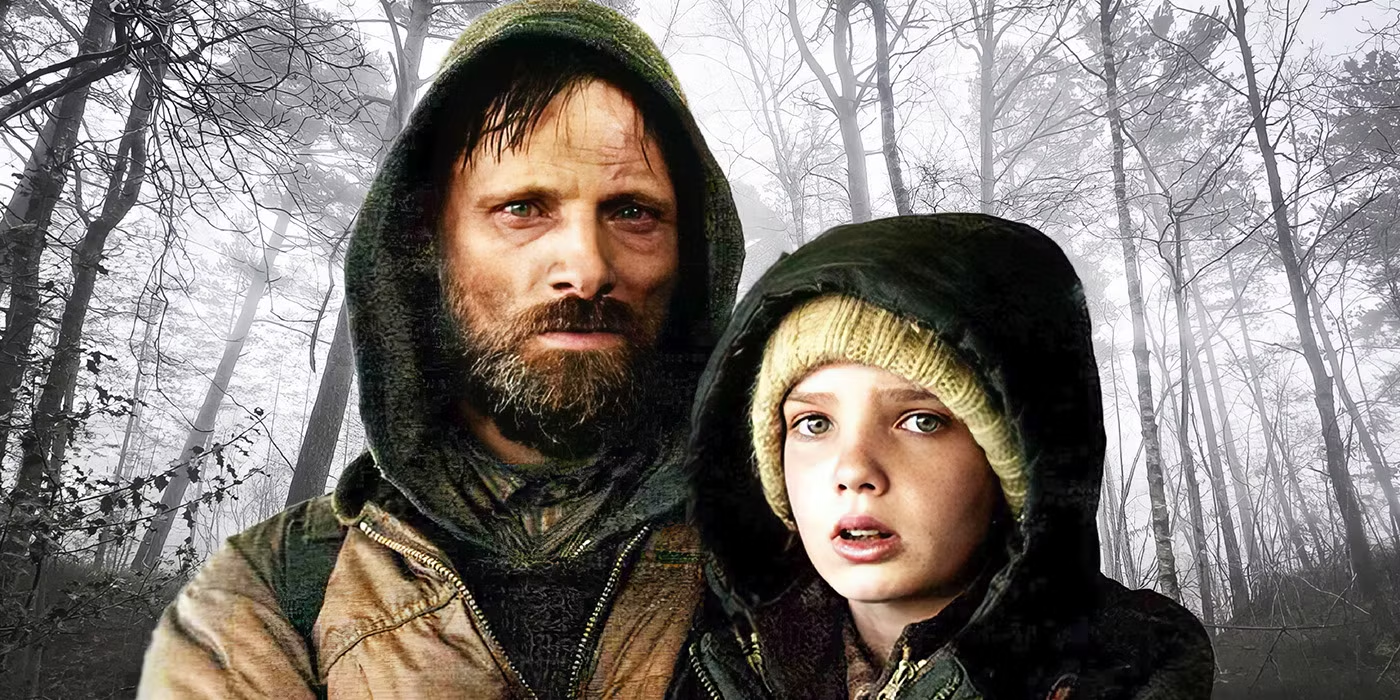
Starvation Rewired Everything About Him
The Clinical Lens
Strip away the apocalypse setting for a moment and look at the father in The Road as a psychological case study. What we’re watching is a man undergoing sustained, severe physiological and psychological deprivation, chronic starvation, constant hypervigilance, repeated exposure to violence and threat, all while carrying full responsibility for another human being’s survival. None of what follows requires supernatural or dramatic explanation. It’s simply what happens to cognition and behavior under this kind of pressure, extended across years rather than days.
Starvation and Decision Making
Chronic caloric deprivation doesn’t just weaken the body, it fundamentally narrows cognitive bandwidth. Studies on famine conditions consistently show that prolonged hunger produces tunnel vision in decision making, an increasing focus on immediate survival calculations at the expense of longer term reasoning or empathy. The film visualizes this directly in the father’s body, the ribs, the cough, the way he moves. But it’s also visible in his decision patterns. His calculations around the old man on the road, food divided by two becoming food divided by three, are a textbook example of scarcity mindset overriding social instinct. The body’s crisis response is quite literally reshaping how he processes every encounter with another human being.
Hypervigilance as a Permanent State
The mirror attached to the shopping cart isn’t a small detail, it’s a diagnostic one. In a stable environment, a mirror is used to check your own appearance. Here, it exists purely to monitor threats approaching from behind. This single object encodes an entire psychological state, a nervous system permanently locked into threat detection mode, unable to relax even during supposedly safe moments. Sustained hypervigilance of this kind is strongly associated with chronic stress responses that physically alter decision making circuitry over time, increasing reactivity and decreasing the ability to assess nuance. It’s a plausible, grounded explanation for why the father’s responses escalate so quickly from caution to violence as the film progresses.
Moral Injury, Not Moral Failure
The term moral injury describes the psychological damage that occurs when a person perpetrates, witnesses, or fails to prevent an act that violates their own deeply held moral beliefs. The father experiences this repeatedly, shooting a man near his son, nearly executing his own child outside the cellar house, stripping a thief of his clothing as punishment rather than necessity. Each of these events isn’t simply an ethical lapse, it’s a wound. Moral injury research shows it produces symptoms resembling trauma, emotional numbing, increasing harshness, difficulty connecting with others, exactly the trajectory we watch the father follow across the film’s second half. He isn’t becoming a worse person by choice. He’s accumulating injuries he has no mechanism to process or recover from.
Why He Can’t Talk About the Disaster
Notice how little the father explains about what actually happened to the world. No scientific explanation, no political context, nothing beyond a flash of light and the instinct to fill a bathtub. Psychologically, this tracks with how people process catastrophic, incomprehensible trauma. When an event exceeds a person’s capacity to make narrative sense of it, the mind often defaults to procedural, task focused responses rather than cognitive processing. He doesn’t need to understand the disaster to respond to it. He only needs to act, and the film shows him doing exactly that, moving straight into survival behavior without ever processing the loss underneath it. That unprocessed grief doesn’t disappear. It resurfaces later as the hardness and harshness he displays toward strangers.
Attachment Under Extreme Conditions
The bond between father and son in this story isn’t simply love in the conventional sense, it’s an attachment system operating under maximum load, with no other adults, no community, and no safety net to diffuse the intensity. In ordinary circumstances, parental attachment is supported by a broader network, other caregivers, social structures, moments of relief. Here, the father is the sole source of protection, information, and emotional regulation for his son, with zero backup. This explains both the depth of his devotion and the severity of his breakdowns when that devotion is threatened. An attachment bond carrying this much unshared weight will produce exactly the kind of extreme protective responses we see outside the cellar house, not because the father is unusually unstable, but because the system supporting ordinary parental bonds has been completely removed.
The Boy’s Different Developmental Path
Interestingly, the boy’s psychology develops along a different track entirely. Having no memory of the previous world, he isn’t carrying the same grief based cognitive load his father is. His moral reasoning develops in something closer to real time, shaped directly by his father’s modeling rather than competing against years of prior experience and loss. This is likely why his empathy remains more intact. He isn’t fighting through accumulated trauma to express kindness, he’s simply expressing it, unobstructed by the psychological wreckage his father is quietly managing underneath every decision.
The Final Diagnostic Moment
When the father dies on the beach and declines to use the last bullet on his son, despite the plan he maintained throughout the entire film, this reads less like redemption and more like a final psychological shift, a dying mind reprioritizing under the ultimate form of acute stress. With his own survival no longer a variable, the narrowing effect of chronic scarcity finally releases, and what surfaces instead is the underlying attachment bond, uncomplicated by threat calculation for the first time in the entire story.
What the Deep Dive Reveals
None of this requires the apocalypse to be literal to feel psychologically true. The Road functions as an extreme case study in how deprivation, hypervigilance, and moral injury reshape a person over time, while a nearby, less burdened mind develops along an entirely different and more intact path. The horror of the film isn’t the cannibalism or the ash. It’s watching a completely explicable, clinically plausible psychological collapse happen to someone whose only crime was trying to keep one other person alive for as long as humanly possible.


