
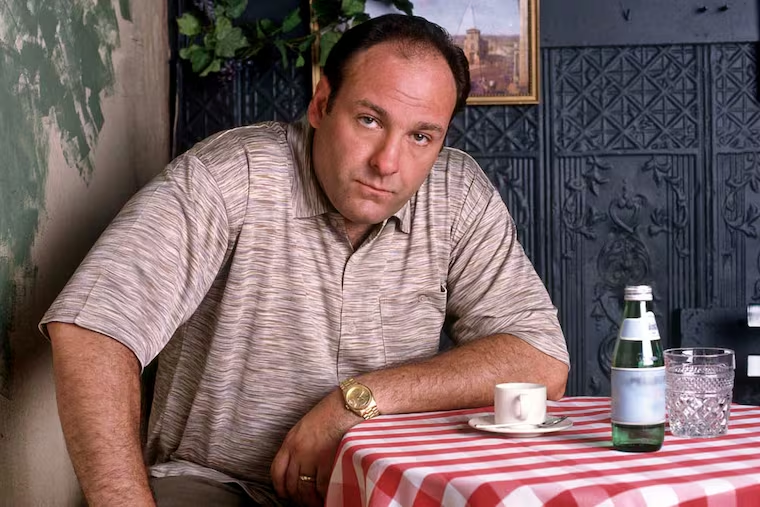
The Gentle Giant Was Television’s Most Dangerous Man
Everyone who worked with James Gandolfini says the same thing. He was gentle. He was generous. He was private and complicated and deeply uncomfortable with the gap between what he earned and what the people around him earned. He handed out bonus checks from his own salary. He was, by every account of the people who knew him, a profoundly decent human being. This is the detail that unmasks everything. Because the most dangerous thing James Gandolfini ever did was not play a violent sociopath. It was play one so convincingly that the culture forgot the gentle man was the real one.
The Mask That Fit Too Well
Most actors who play villains maintain a visible seam between themselves and the character. You can see the craft. You can appreciate the performance as a performance. The seam is part of the experience. It reassures the audience that what they are watching is constructed, that the darkness is contained, that the actor goes home to something different.
Gandolfini eliminated the seam. His central technical innovation was the fusion of contradictory emotional states, the simultaneous expression of vulnerability and violence, tenderness and cruelty, love and the capacity for destruction. He achieved this by refusing to treat the character as something separate from himself. He used his own physical mass, his own exhaustion, his own carefully engineered discomfort as the raw material of the performance.
The mask fit so well because it was not entirely a mask. The emotional truth Gandolfini brought to Tony Soprano was real emotional truth, extracted from a real person through methods that were genuinely costly. The performance was authentic because the man making it was genuinely spending something to make it. And the thing he was spending was himself.
What the Audition Actually Revealed
The story of Gandolfini’s audition is usually told as a triumph of persistence. He stopped in the middle. He walked out. He demanded a do-over because he thought he was bombing. He assumed the network wanted someone else, some handsome, conventional leading man type. He came back and won the role.
But the audition story reveals something more uncomfortable than persistence. It reveals a man who was already, before a single episode had been filmed, in a state of profound self-doubt about his right to occupy the space the role required. He did not walk out because he was arrogant. He walked out because he was terrified. He came back not because he was confident but because the alternative was worse.
This is the psychological profile of a man who will spend a decade overcompensating for that terror through preparation, through physical self-punishment, through the systematic elimination of any gap between himself and the character that might allow doubt to enter. The audition did not reveal a future star. It revealed the mechanism that would make him one and the cost that mechanism would extract.
The Gentle Man Carrying the Monster
Lorraine Bracco asked Gandolfini what he felt underneath during a helpful, conciliatory scene. He laughed and said he wanted to take her like a rabbit and twist her head off. He was joking. The laugh confirmed it was a joke. But the joke was also the truth of what it meant to carry Tony Soprano’s darkness inside a gentle man’s body for a decade.
The unmasking that Nightcrawler performs on Lou Bloom, the revelation that the corporate language is not a disguise but the entire person, Gandolfini’s career performs in reverse. The revelation is not that the monster was always there underneath the gentleness. The revelation is that the gentleness was always there underneath the monster, and that the culture only wanted the monster, and that the gentle man had to keep feeding the monster for ten years because that was the job.
The Misread as Unmasking
The culture’s misreading of Tony Soprano is itself an unmasking, just not of the character. When millions of viewers watched a portrait of masculine collapse and responded by cheering for the collapse, they revealed something about themselves. They revealed that the culture Gandolfini was critiquing was not ready to receive the critique. They revealed that the audience for a story about the psychological cost of performed masculinity was primarily composed of people who wanted to celebrate performed masculinity.
Gandolfini was disturbed by this. He said so. He had built something true and the culture had absorbed it as something comfortable, and the gap between what he intended and what the audience received was the gap between the gentle man and the monster, the gap he had spent a decade trying to close in the performance and that the audience had spent a decade refusing to see.
The Legacy the Culture Got Wrong
James Gandolfini did not invent the morally complex protagonist. He changed how emotional contradiction is portrayed on screen. He gave the culture a blueprint for building characters who feel biologically human rather than dramatically constructed. The actors and showrunners who followed him took the blueprint and optimized it. They made the antiheroes smarter, more self-aware, more carefully designed for the internet culture that was emerging.
They removed the thing that made the blueprint work. They removed the ugliness, the impulsiveness, the genuine pathetic quality of a man making deeply stupid decisions driven by pure ego. They removed the gentle man underneath the monster because the gentle man was the expensive part, the part that required a performer willing to actually spend something real to make it true.
The unmasking of James Gandolfini is the unmasking of what television lost when it lost him. Not the performance. Not the blueprint. The willingness to be genuinely, uncomfortably, expensively human in front of the camera. The gentle giant was television’s most dangerous man because he made the audience feel something real. And the culture, as it always does with things that cost something real, found a way to make it cheaper.


