Movie They Live – Why That Fight Scene Explains Human Denial
The Most Uncomfortable Scene in Cinema Is Also the Most Honest
Five minutes and twenty-six seconds. That is how long the alley fight lasts in John Carpenter’s They Live. Two men. A pair of sunglasses. And one of the most psychologically accurate depictions of human denial ever committed to film.
Critics in 1988 called it self-indulgent. Film students debate whether it was necessary. Internet culture turned it into a meme. But strip away the jokes and the meta-commentary, and what you’re left with is a scene that explains something fundamental about the human mind, something that psychology has spent decades trying to articulate, and that Carpenter captured in a single brutal sequence.
People do not want to wake up. And they will fight, with everything they have, to stay asleep.
What Actually Happens in the Alley
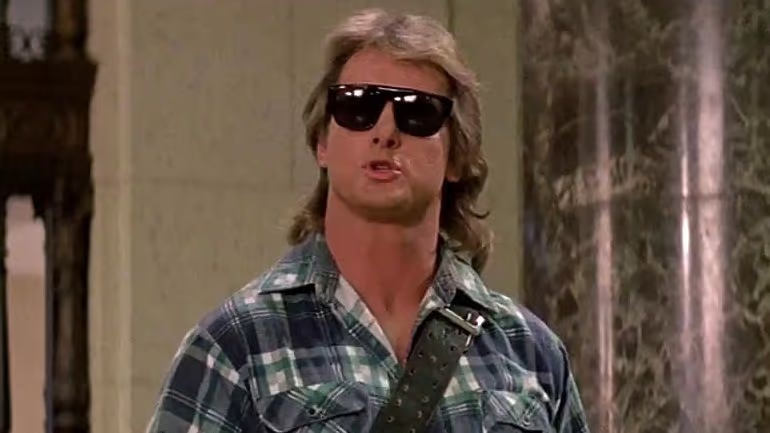
Nada has found the sunglasses. He has seen the truth — the hidden commands embedded in every advertisement, the alien faces beneath the human masks of the elite, the architecture of control that structures everyday life. He wants his friend Frank to see it too.
He asks Frank to put on the glasses. Frank refuses. Nada insists. Frank refuses again. What follows is not a conversation. It is not a debate. It is a prolonged, exhausting, brutal physical confrontation that ends only when Frank is physically incapacitated and the glasses are forced onto his face.
And then Frank sees. And everything changes.
The question the scene poses, the question Carpenter never explicitly answers, is why. Why did it take a fistfight? Why couldn’t Nada simply explain what he had seen? Why did Frank resist so violently?
The Psychology of Comfortable Ignorance
The answer lies in what psychologists call motivated reasoning. Human beings are not primarily truth-seeking creatures. We are comfort-seeking creatures who use reasoning to defend our existing beliefs rather than to discover new ones. When information arrives that threatens our worldview, we don’t evaluate it neutrally. We attack it. We find reasons to dismiss it. We experience the threat to our beliefs as a threat to our identity.
Frank’s resistance in the alley is not stupidity. It is not cowardice. It is the entirely rational response of a person who has built a life within a particular understanding of reality and is being asked to demolish that understanding with no guarantee of what comes next.
The comfortable world, the world without the glasses, is not pleasant. Frank is a struggling worker in a brutal economy. But it is a world he understands. He knows the rules. He knows his place. He knows how to survive. The world Nada is offering him is one where everything he thought he knew is wrong, where the rules are revealed as a rigged game, where survival requires confronting a truth so large and so dark that most people would rather not know it.
Ignorance, in this context, is not a failure. It is a coping mechanism.

The Backfire Effect in Action
In 2010, researchers Brendan Nyhan and Jason Reifler documented what they called the backfire effect: the phenomenon whereby presenting people with factual corrections to their false beliefs causes them to hold those beliefs more strongly, not less. The correction triggers a defensive response. The person doubles down.
Carpenter dramatized this in 1988 without the benefit of the research. When Nada presents Frank with the glasses, with direct, irrefutable evidence of the hidden reality, Frank doesn’t say “let me consider this.” He says no, and then he starts throwing punches.
The backfire effect has since been refined and debated by researchers, but the core insight holds: confronting people with uncomfortable truths is not a reliable method of changing their minds. The mind has defenses. Those defenses are strong. And the more important the belief is to a person’s sense of identity and security, the stronger those defenses become.
Why the Fight Had to Be That Long
The length of the alley fight is not an accident and it is not self-indulgence. It is a statement about the cost of awakening.
A short fight would suggest that resistance to truth is easily overcome, that a brief struggle is all that stands between ignorance and enlightenment. The five-minute duration communicates something different: this is hard. This costs something. Both men are exhausted, bloodied, and broken by the end of it. The truth does not arrive cheaply.
This is the part of awakening narratives that most films get wrong. The hero takes the red pill and immediately sees clearly. The scales fall from their eyes in a single dramatic moment. The transition from ignorance to enlightenment is presented as painful but swift.
They Live refuses this comfort. The transition is painful and slow and ugly and it requires someone willing to absorb an enormous amount of punishment in service of forcing another person to simply look.
What This Means in 2026
The alley fight is more relevant in 2026 than it was in 1988, because the mechanisms of comfortable ignorance have become more sophisticated and more personalized.
In 1988, the commands were broadcast uniformly: OBEY. CONSUME. SLEEP. Everyone received the same signal. The glasses, once found, revealed a shared hidden reality.
In 2026, the signal is individualized. Algorithms learn your specific psychology — your fears, your desires, your tribal affiliations — and deliver a customized version of the comfortable illusion. Your feed is not the same as your neighbor’s feed. Your reality tunnel is uniquely constructed to keep you engaged and unquestioning.
This means the alley fight has to happen differently now. You cannot simply hand someone a pair of glasses and show them the hidden commands, because the commands are different for everyone. The awakening has to be personalized too. And that makes it harder, slower, and more exhausting than anything Carpenter depicted.
The Scene’s Lasting Gift
The alley fight in They Live is a gift to anyone who has ever tried to change someone’s mind about something important and failed. It says: this is not your fault. This is not their fault. This is what awakening looks like. It is ugly and it costs something and it doesn’t always work.
But sometimes, after the fight is over and the glasses are on and the person finally looks — sometimes it does work. And that, Carpenter suggests, is worth the bruises.
The question for 2026 is not whether the fight is worth having. It is whether we have the endurance to keep fighting it.