
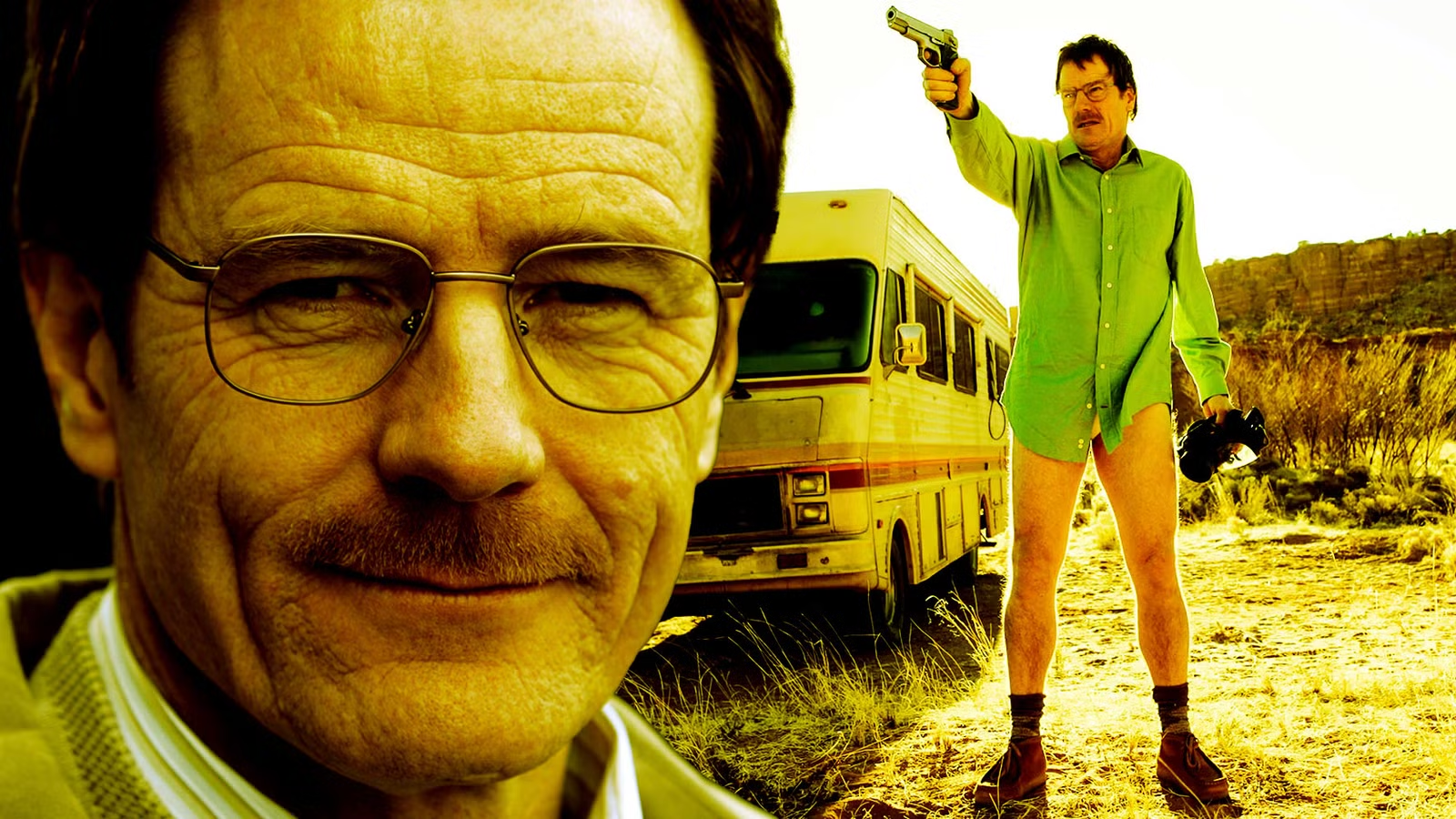
Breaking Bad Predicted the Death of the Antihero Era, Then No One Listened
Breaking Bad ended in 2013 with a clear, unambiguous statement about what television had been doing wrong for a decade.
Nobody listened.
In the years that followed, streaming platforms flooded the market with antiheroes. Morally compromised protagonists, men of violence with sympathetic backstories, brilliant criminals the audience was invited to root for, all of them wearing the aesthetic of Breaking Bad while quietly discarding everything that made it matter. They kept the darkness. They kept the moral ambiguity. They kept the brooding male protagonist with a secret and a justification.
What they threw away was the consequences. What they abandoned was the truth. What they refused to carry forward was the one thing that made Breaking Bad genuinely revolutionary, its absolute, uncompromising refusal to let anyone off the hook.
What the Show Actually Said
To understand what Breaking Bad predicted, you have to understand what it was actually arguing.
The show was not a celebration of the antihero. It was a dissection of one. Every choice Vince Gilligan and his writers made, from the visual language to the pacing to the ending, was designed not to make Walter White cool, but to make him legible. To strip away every comfortable excuse the audience might reach for and force them to see the man underneath the mythology.
The camera did not flatter Walter. It observed him, with a cold, unflinching honesty that most television is too commercially cautious to attempt. The direction was defined by stillness, by long holds on uncomfortable moments, by a refusal to cut away before the audience had fully absorbed what they were watching. Violence was framed as consequence, not spectacle. The aftermath was shown, not the act. The imagination was trusted to fill the gap, and what the imagination produced was always worse than anything the show could have put on screen.
This was a deliberate artistic choice, and it carried a deliberate artistic argument. The argument was this: if you show a man doing terrible things and make it look exciting, you are lying. If you show a man doing terrible things and force the audience to sit with the full weight of what those things cost, you are telling the truth. Breaking Bad chose truth. Consistently, uncomfortably, at significant commercial risk.

The Antihero Formula It Refused to Follow
By 2008, when Breaking Bad premiered, the antihero had become television’s dominant mode. Tony Soprano had opened the door. Don Draper had walked through it. The formula was well established and enormously profitable. Give the audience a brilliant, damaged man. Let him do terrible things. Make sure he is charming enough, wounded enough, and occasionally vulnerable enough that the audience never fully withdraws their sympathy. Keep the moral ledger perpetually unresolved so the audience can project whatever they need onto him.
Breaking Bad looked at that formula and rejected it entirely.
Walter White is not charming in the way Tony Soprano is charming. He is not romantically tragic in the way Don Draper is tragic. He does not have the roguish magnetism that makes an audience forgive a man his sins before he has finished committing them. What he has is a seductive internal logic, a wounded pride that feels familiar, a resentment that resonates. But the show never lets that resonance become absolution. It keeps pulling the camera back, keeps widening the frame, keeps insisting that the audience see not just Walter’s perspective but the full landscape of damage his perspective creates.
Jesse Pinkman is the mechanism for that insistence. He is the show’s moral receipt, the living tally of everything Walter’s pride costs in human terms. Jesse feels guilt. He suffers for his empathy. He carries the weight of every destroyed life in a way Walter never does, and the show punishes him for it, relentlessly, because in the world Breaking Bad describes, empathy is not a virtue. It is a tax, paid in blood. The show makes you watch Jesse pay it over and over again, so you cannot pretend the cost does not exist.
What Came After, and Why It Failed
The shows that followed Breaking Bad in its wake understood its surface and missed its soul.
They saw the visual grammar, the moral complexity, the antihero protagonist, and they replicated all of it faithfully. What they did not replicate was the discipline. The willingness to let consequences land without softening them. The refusal to give the audience an emotional exit when the story became genuinely uncomfortable.
Modern television, shaped by the economics of streaming and the analytics of engagement, has a deep institutional allergy to unresolved discomfort. Audiences can be made to feel bad, but only temporarily, only as a prelude to relief. The antihero can do terrible things, but there must always be a moment of redemption, or at least of humanization, that allows the audience to exhale. The moral ledger must never fully close, because a closed ledger means the audience has to make a judgment, and a judgment means some of them will walk away.
Breaking Bad closed the ledger. Completely, without apology, in the final moments of its final episode. Walter White does not get redemption. He gets honesty. He admits, to himself and to Skyler, that he did it for himself, that he liked it, that he was good at it. There is no absolution in that admission. There is only the truth of who he was, stated plainly, without the comfort of regret.
That ending was a rebuke to every antihero narrative that had come before it, and a warning to every one that would come after. It said, clearly: this is what it looks like when you follow the logic all the way to the end. This is what happens when you refuse to flinch.
The Warning Nobody Heeded
The irony is precise and painful. Breaking Bad demonstrated, with complete artistic authority, that the antihero formula was built on a lie, that the genre only worked because it kept cheating, kept pulling its punches, kept offering the audience just enough moral comfort to keep them watching without feeling implicated.
And then the industry looked at Breaking Bad’s extraordinary success, its cultural dominance, its critical legacy, and concluded that the lesson was: make more antiheroes.
They made more antiheroes. They made dozens of them. They gave them all the darkness and the moral complexity and the brooding visual grammar. They gave them none of the consequences. None of the discipline. None of the honesty.
Breaking Bad did not just predict the death of the antihero era. It demonstrated, in five seasons of surgical precision, exactly how and why the genre would eventually collapse under the weight of its own dishonesty.
The show told the truth. The industry heard the applause and missed the argument entirely.


