

Adrien Brody: He Won the Oscar, Then Disappeared
One night you’re kissing Halle Berry on the Oscar stage. The next, nobody can quite remember what you’ve been doing for the last ten years.
That’s not an exaggeration. That’s the Adrien Brody story, one of the most jarring vanishing acts in modern Hollywood history. Not a scandal. Not a breakdown. Not a public meltdown that explained everything in a single headline. Just a slow, quiet fade from the center of the frame to somewhere at the edges, where the light doesn’t quite reach.
He won the Academy Award for Best Actor in 2003. He was 29 years old, the youngest man to ever claim that title. He had the talent, the momentum, and the cultural moment. And then, with no dramatic explanation, he was simply… gone. Not from acting. From relevance. From the conversation. From the list of names that studios reached for when they needed someone to carry a film.
The disappearance wasn’t an accident. It was the inevitable result of a collision between one of cinema’s most singular talents and an industry that had quietly decided it no longer had room for him.
The Night Everything Changed
To understand the disappearance, you have to start at the peak.
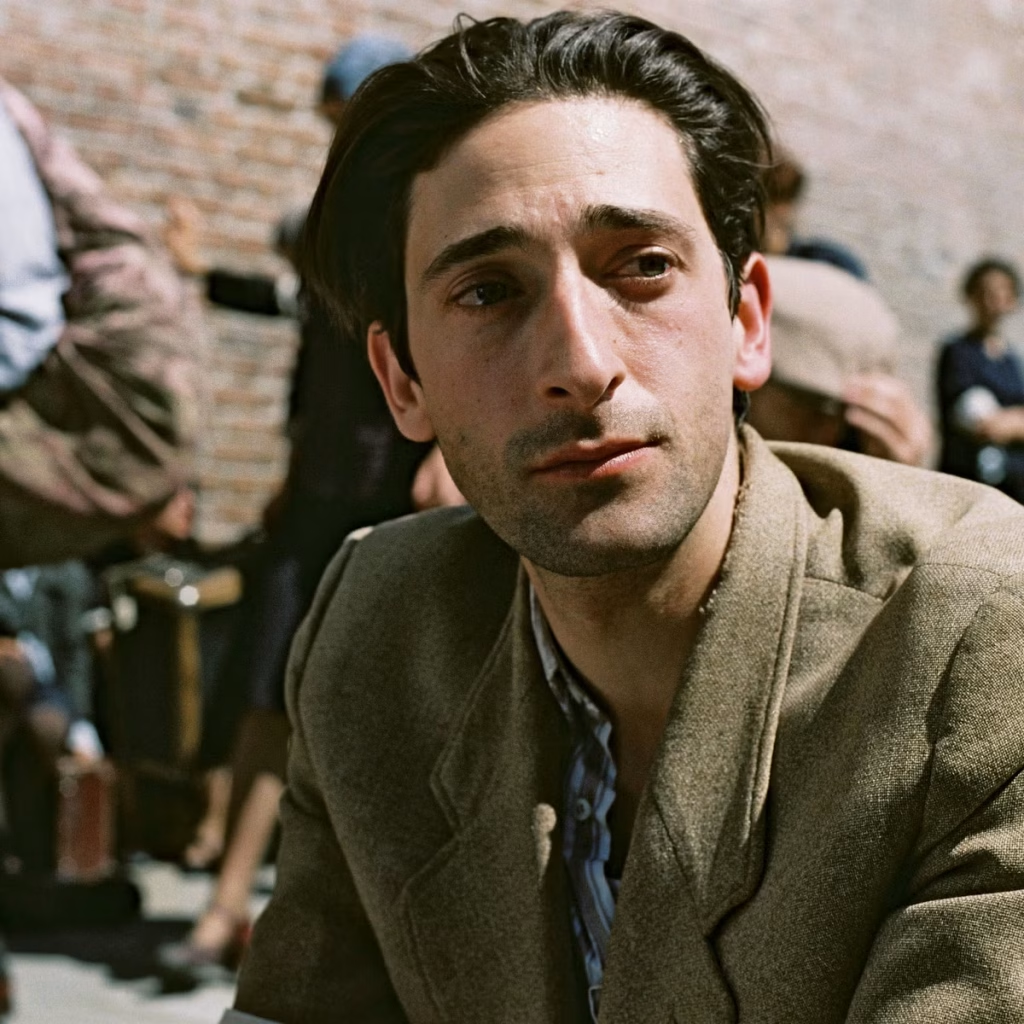
March 23, 2003. The 75th Academy Awards. Brody takes the stage to accept the Best Actor award for his role in Roman Polanski’s The Pianist, a performance that had required him to give up his apartment, sell his car, move to Europe, starve himself to 129 pounds, and practice Chopin for four hours every single day. He had refused a hand-double for the piano sequences. He had poured everything he had into the role, and the industry had responded with its highest honor.
He kissed Halle Berry. He delivered a somber, emotional speech pleading for peace as the Iraq War loomed. He had the raw, complex gravity of a young Dustin Hoffman. The room was electric. The future felt limitless.
Within a few years, the phone had stopped ringing the way it used to. The A-list had quietly closed its doors. And Adrien Brody had begun the long, disorienting process of figuring out what comes after the peak, when the peak turns out to be a cliff edge.
Why the Phone Stopped Ringing
The disappearance had a cause, and it wasn’t anything Brody did wrong.
Hollywood was changing. Fast. The mid-budget adult drama, the natural home of an actor with Brody’s particular gifts, was being systematically replaced by the superhero franchise machine. Studios were no longer building their slates around complex, character-driven stories. They were building them around intellectual properties, cinematic universes, and the kind of leading men who could anchor a sequel, a spin-off, and a theme park ride simultaneously.
Brody didn’t fit that template. He was too expensive for the independent films that suited his talent, and too unconventional, too strange, too interior, too genuinely interesting, to lead a $200 million blockbuster. The industry had elevated him to a level where the roles that actually matched his abilities no longer existed at the budget required to justify his name above the title.
He had won the Oscar at the exact moment the world the Oscar represented was disappearing. The timing was almost cosmically cruel.
The Attempts to Stay Visible
To his credit, Brody didn’t disappear without a fight.
King Kong in 2005 was the most visible attempt to stay in the mainstream conversation. Peter Jackson’s blockbuster remake needed a leading man, and Brody, Oscar winner, global name, seemed like a reasonable bet. The film grossed nearly $557 million worldwide. It should have been a launchpad. Instead, it was a demonstration of the fundamental mismatch between what Brody was and what the blockbuster era demanded. He was a precision instrument in a film that needed a blunt object. The money was there. The fit wasn’t.
Predators in 2010 was the second attempt, this time with Brody physically transforming himself, gaining 25 pounds of muscle, lowering his voice, doing everything the industry asked. It still didn’t work. You can change a man’s body. You can’t change the intelligence behind his eyes, or the fact that he has the face of a 1940s poet rather than a modern action figure.
After that, the mainstream roles dried up. He took lucrative international projects, Chinese blockbusters that paid well and baffled his American audience in equal measure. He drifted. He wandered. He found creative sanctuary with Wes Anderson, becoming an essential presence across five films, but that world, however artistically rich, wasn’t the mainstream. It was a beautiful, curated corner of cinema that the general audience barely noticed.
The Years Nobody Talks About
The middle of the Brody story is the part that gets skipped in the comeback narratives, because it’s uncomfortable to sit with.
He was in box-office purgatory. Too expensive for small films, too unconventional for big ones. The middle class of cinema — the space where his talent had always lived, had been eliminated. He pivoted to visual art, debuting a painting exhibition titled Hot Dogs, Hamburgers, and Handguns that critiqued the instant gratification of American violence. It was a genuine, serious artistic statement. It was also the act of a man who had stopped waiting for an industry to figure out what to do with him and had decided to create on his own terms instead.
Those years weren’t failure. They were survival. But survival and thriving are not the same thing, and anyone who watched Brody during that period could see the gap between what he was capable of and what he was being given the opportunity to do.
The Return From the Shadows
The comeback didn’t announce itself. It crept in quietly, the way Brody himself tends to operate.
Prestige television was the first signal. His work on Peaky Blinders was a masterclass in controlled menace. His appearance on Succession was devastating in its precision. Audiences who had half-forgotten him were suddenly reminded, or perhaps discovered for the first time — what a genuinely extraordinary screen presence looked like.
Then came The Brutalist. Brady Corbet cast him as a Jewish architect surviving historical trauma, a role with undeniable thematic echoes of The Pianist — as if cinema itself was offering him a second chance to show what he had always been capable of. He poured twenty years of industry frustration into the performance. The result was a monumental, career-defining achievement that felt less like a comeback and more like a reckoning.
In March 2025, at 51 years old, Adrien Brody won his second Academy Award for Best Actor. The youngest winner in history had become a two-time winner. The man who had disappeared was back, and the industry that had let him vanish was applauding.
What the Disappearance Actually Tells Us
Here’s the thing about Adrien Brody’s vanishing act: it was never really about him.
He didn’t disappear because his talent faded. He didn’t disappear because he made bad choices or burned bridges or stopped caring. He disappeared because the industry that had crowned him decided, almost immediately afterward, that the kind of actor he was no longer had a place in the films it wanted to make.
The disappearance was Hollywood’s confession. A quiet, unintentional admission that the system had reorganized itself around values, spectacle over substance, franchise over character, safety over risk, that had no room for someone like Adrien Brody.
He won the Oscar. Then he disappeared. Then he came back and won again.
The real question isn’t where he went. It’s why it took the industry twenty-two years to remember what it had.


