The Pride Addiction: How Walter White’s Real Drug Wasn’t Meth, It Was Finally Being Feared
Walter White never wanted to get high.
He wanted to be seen.
This is the detail that most Breaking Bad conversations skip past, the detail buried beneath five seasons of chemistry and violence and moral collapse. The show is discussed endlessly in terms of its antihero narrative, its visual language, its place in the television canon. What gets discussed far less is the specific, clinical nature of Walter’s addiction, the one that was present long before the first cook, long before the cancer diagnosis, long before any of it.
Walter White was addicted to recognition. And like every addiction, it started small, felt justified, and eventually consumed everything around it.
The Drug That Was Always There
Addiction specialists will tell you that the substance is rarely the point. The substance is the delivery mechanism for something the addict has been chasing long before they found their drug of choice. The relief from anxiety. The silencing of shame. The brief, chemical approximation of feeling like enough.
For Walter White, the drug of choice was fear. Specifically, the fear he could generate in other people. The respect that fear produced. The recognition that respect implied.
Before Breaking Bad begins, Walter has spent decades being invisible. Not literally, not socially, but in the way that matters most to a man of his particular psychology. He is not seen for what he believes himself to be. He is a high school chemistry teacher in Albuquerque, a man who co-founded a company that became worth billions and walked away with nothing, a man whose intellectual gifts are wasted on teenagers who do not care, whose domestic life is comfortable and suffocating in equal measure. He is, by every external measure, fine. And being fine, when you believe you are exceptional, is its own form of slow torture.
The cancer does not create the addiction. It simply removes the last barrier between Walter and the thing he has always wanted. It gives him permission to stop pretending that fine is enough.
The First Hit
The moment Walter White first experiences the drug that will destroy him is not when he cooks methamphetamine. It is earlier, quieter, and far more revealing.
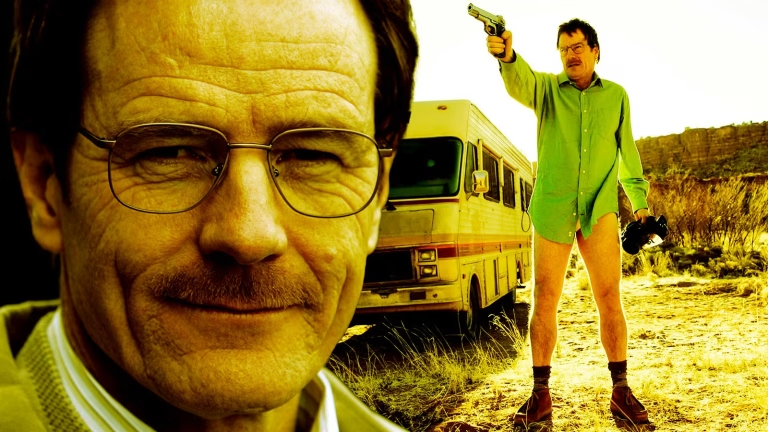
It is the moment a drug dealer realizes that the mild-mannered chemistry teacher in the RV is not afraid of him. That this man, this nobody, this person who should by every social logic be terrified, is instead calm. Controlled. Dangerous.
The look on that dealer’s face is the first hit. And Walter feels it the way an addict feels that first rush, with a clarity and a completeness that nothing in his previous life has ever matched. He is seen. Not as a teacher, not as a husband, not as a patient, but as someone to be reckoned with. Someone to be feared.
Everything that follows is Walter chasing that feeling. The meth is incidental. The empire is incidental. The money, which he eventually has so much of that he cannot spend it, is almost entirely incidental. What Walter is building, with every cook and every confrontation and every line crossed, is a more reliable delivery system for the only thing that has ever made him feel truly alive.

The Anatomy of the Addiction
What makes Walter’s addiction so psychologically precise, and so uncomfortable to watch, is that it follows the exact trajectory of every other addiction the show could have chosen.
Tolerance builds. The early hits, the small moments of being feared by small people, stop being enough. Walter needs more. He needs bigger adversaries. He needs a larger territory. He needs a name, Heisenberg, that exists separately from Walter White, a persona built entirely around the projection of danger. He needs people not just to fear him but to know his name when they fear him.
Withdrawal is catastrophic. The moments when Walter is stripped of his power, when he is just a man in a car wash, just a patient in a waiting room, just a husband in a difficult marriage, are the moments when the show is most uncomfortable to watch. Not because of violence or moral transgression, but because of the raw, undisguised desperation of a man in the grip of a craving he cannot name to anyone around him.
Relationships are destroyed in service of the addiction. Skyler, Walt Jr., Jesse, Hank, every relationship in Walter’s life is eventually sacrificed on the altar of his need to be feared. Not because he does not love these people, in his way, but because love requires vulnerability, and vulnerability is the opposite of the thing he is addicted to. You cannot be feared by the people who have seen you afraid.
The Confession That Proves the Diagnosis
Breaking Bad ends with Walter White making the only honest statement he has made in five seasons.
“I did it for me. I liked it. I was good at it. And I was really, I was alive.”
This is not a confession of evil. It is a confession of addiction. The language is identical to what you would hear from anyone describing the first time their drug of choice worked. The relief of it. The rightness of it. The terrifying, clarifying sensation of feeling, for the first time, like the person you were always supposed to be.
Walter was alive when he was feared. He was not alive before. Not really. He was performing aliveness, going through the motions of a life that fit him the way a suit fits a man two sizes too large. The cancer did not make him feel alive. The cooking did not make him feel alive. The money did not make him feel alive.
The fear in other people’s eyes made him feel alive. That was the drug. That was always the drug.
What the Addiction Cost
Every addiction ends the same way. Either the addict finds a way out, or the addiction takes everything.
Walter White’s addiction took everything. His marriage, his relationship with his son, his freedom, his health, his life. It took Jesse Pinkman’s peace of mind, his relationships, his capacity for joy. It took Hank Schrader’s life. It took Jane. It took Andrea. It left a trail of destroyed people stretching from Albuquerque to the Czech Republic, all of them collateral damage in one man’s compulsive pursuit of the feeling of being feared.
And at the end, in a meth lab in New Hampshire, bleeding out on a concrete floor, Walter White finally gets what every addict eventually gets. Not the high. The clarity that comes after the high is gone for the last time.
He was never going to stop. Not because he could not, but because the addiction had long since stopped being about the feeling and become about the only identity he had ever truly wanted.
He was the one who knocks.
And the door, in the end, opened only one way.